

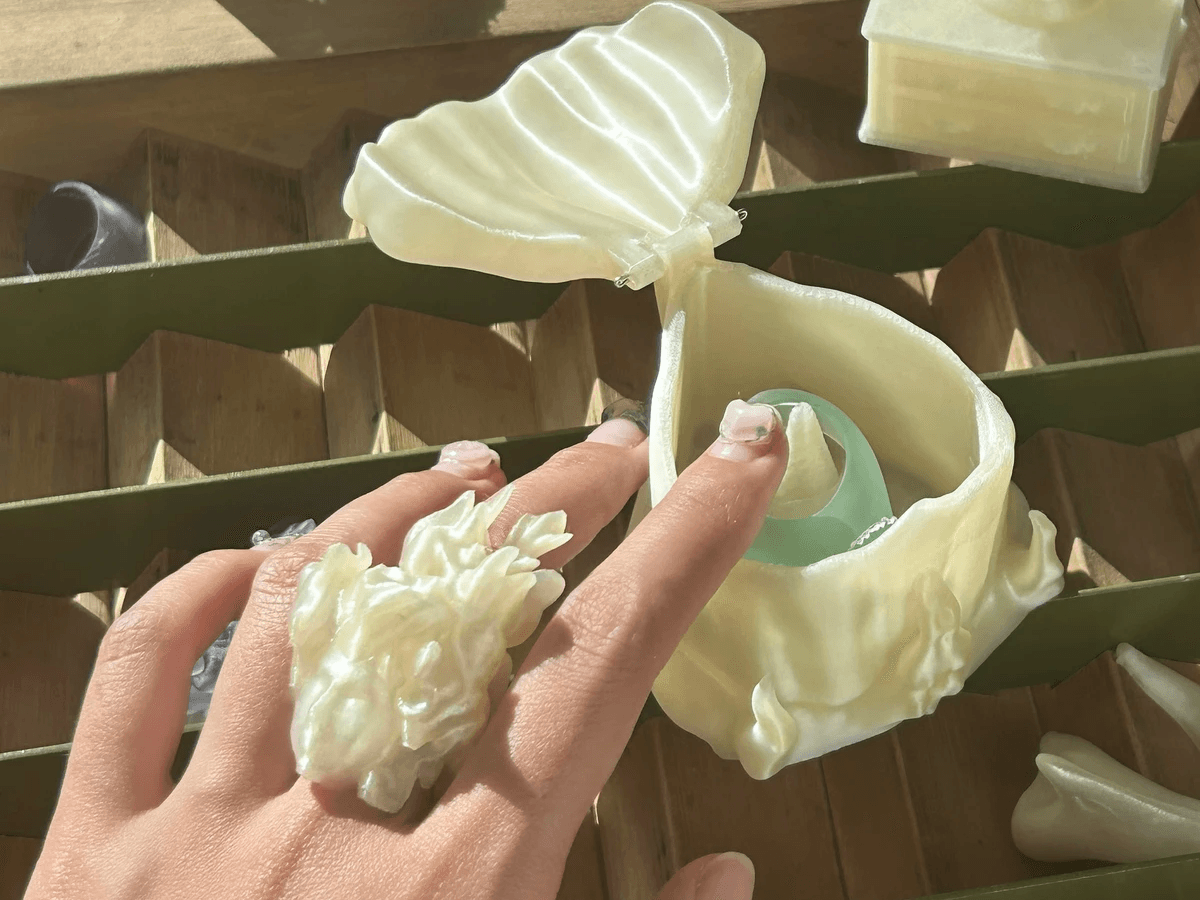
When the natural gifts of microorganisms meet the creative freedom of 3D printing, something magical happens — a collision of sustainability and design that feels both fresh and inevitable. Today, the PHA ECO GOODS team is delighted to announce our long‑awaited collaboration with London-based 3D‑printed accessories brand @TheDigitalAmber. Together, we proudly present the Medusa Ring, an artful piece crafted with our signature Loopha PHA 3D Printing Filament.
The Hidden Power of Microbes
Nature is full of quiet miracles, and microorganisms are among its most remarkable. Many of them naturally produce polyhydroxyalkanoates (PHA) — a unique, bio-based “fat” that stands as one of the most promising sustainable materials of our time. PHA is fully biodegradable in natural environments, leaving no trace of pollution, and its potential applications span an extraordinary range:
- everyday tableware and packaging
- textiles and wearable materials
- food industry additives
- medical implants and devices
Across these fields, PHA offers a compelling, eco-friendly alternative to traditional plastics.
Decades of Research Behind a “Perfect” Material
Behind this seemingly ideal material lies over 30 years of dedicated research and refinement by the PHA ECO GOODS team. Countless scientists and engineers have poured their expertise into unlocking PHA’s potential. Yet despite its advantages, PHA has faced a major barrier on its path to commercialization: cost.
PHA remains 2–5 times more expensive than PLA or conventional plastics, making many manufacturers hesitant and slowing its entry into mainstream markets.
Why Loopha Matters in the 3D Printing World
The 3D printing filament market faces its own environmental challenges. Today, around 70% of PLA filaments contain non‑degradable additives to improve performance — a compromise that strips PLA of its intended sustainability and ultimately contributes to plastic pollution.
Loopha takes a different path.Our Loopha PHA 3D Printing Filament is:
- 100% bio‑based and fully biodegradable
- produced under strict eco‑friendly standards
- engineered for reliable, fast, and stable printing
- capable of withstanding heat deflection temperatures up to 120°C
- naturally endowed with a smooth, jade‑like finish that elevates both visual and tactile quality
Loopha proves that sustainable materials can be both high‑performance and beautiful.
Why We Believe PHA Is the Future
Some may wonder why we insist on developing PHA specifically for 3D printing and building the Loopha brand around it. The answer is simple: we believe PHA is a world‑changing material — the true “plastic of the future.”
Its biodegradability addresses pollution at the source.3D printing, with its speed, flexibility, and personalization, accelerates adoption.
Together, they create a powerful pathway for bringing sustainable materials into everyday life.
Collaboration as a Catalyst for Change
In a world increasingly aligned around sustainability, we know that no single team can drive a materials revolution alone. Real change requires collaboration. Our partnership with @TheDigitalAmber is a perfect example of how design can amplify the value of eco‑friendly materials.
Through the designer’s creativity, Loopha PHA transforms into pieces that carry both aesthetic beauty and environmental meaning. Every object printed with Loopha is more than a design — it is a small but meaningful act of environmental stewardship.
A Future Built on Sustainable Creativity
Sustainability is not a slogan. It lives in every material choice, every design decision, every product brought into the world. PHA ECO GOODS will continue advancing PHA research, expanding the Loopha filament family, and exploring new applications across industries. We will also continue partnering with designers, brands, and creators who share our vision of a more sustainable future.
If you’re curious about Loopha PHA 3D Printing Filament and want to explore the creative possibilities of eco‑friendly materials, visit our official website: https://www.phaecogoods.com/